
Nadal vs Federer: The Unforgettable Battle of Surfaces
I still remember that incredible day in 2007 when tennis witnessed something truly magical - Rafael Nadal and Roger Federer competing on a court that was literally split down the middle between clay and grass. This wasn't just any exhibition match; this was the 'Battle of Surfaces,' a million-pound experiment that pitted the king of clay against the maestro of grass.
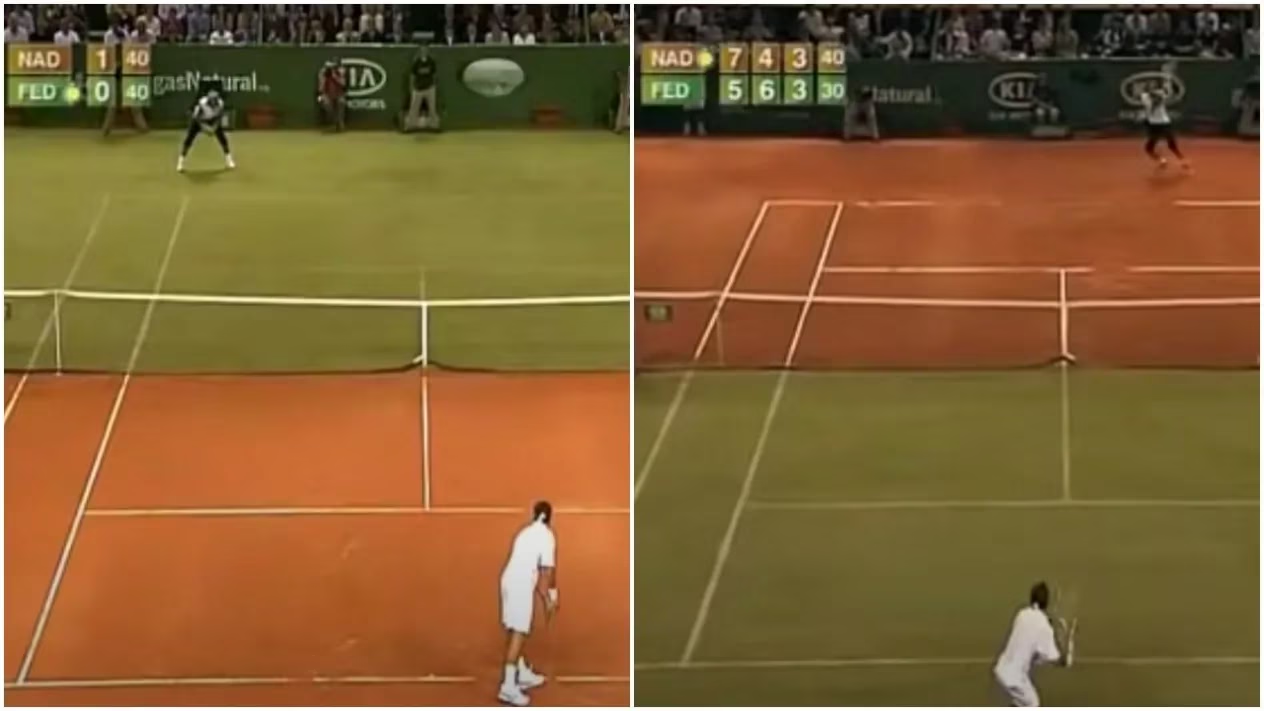
The sheer audacity of creating this hybrid court still blows my mind. Imagine - one side featuring the slow, demanding red clay that Nadal dominated, while the other boasted the fast, slick grass where Federer reigned supreme. The organizers spent over £1 million just to make this fantasy court a reality in Mallorca, and boy, was it worth every penny!
What made this matchup so special was the timing. Federer was riding an incredible 48-match winning streak on grass, while Nadal hadn't lost on clay in over three years. Talk about an unstoppable force meeting an immovable object! I can still hear Federer's pre-match comments echoing: "We are both looking forward to this absolutely new event. The idea really appeals to me as we both dominate one of the surfaces."
The atmosphere was electric with 7,000 spectators packed into the venue, all wondering the same thing - how would these legends adapt to switching surfaces every other game? Would Federer's graceful grass game translate to clay? Could Nadal's powerful baseline game work on grass?

The match itself was like watching a tennis version of Dr. Jekyll and Mr. Hyde:
-
First Set (Clay side dominant): Nadal's clay-court prowess shone through as he took it 7-5
-
Second Set (Grass side advantage): Federer bounced back beautifully, winning 6-4
-
Final Set (The ultimate test): A nail-biting 12-10 tie-break victory for Nadal
Honestly, watching them adapt was like seeing two master painters suddenly forced to work with unfamiliar brushes. Federer had to dig deep into his clay-court arsenal, while Nadal had to quicken his reflexes for the grass. The way they problem-solved in real-time was nothing short of genius.
Nadal's post-match reaction said it all: "It was a good experience, although before the game I thought it would be a disaster because I felt it would be very difficult for me to adapt to the court." That's the understatement of the century coming from someone who's now won the French Open 14 times!
Looking back from 2025, this match feels like a time capsule from tennis's golden era. With Federer retired and Nadal's career winding down, we can truly appreciate how special this rivalry was. They weren't just playing for points that day - they were testing the very boundaries of their sport.
What made this battle so memorable?
| Aspect | Why It Mattered |
|---|---|
| Surface Innovation | First and only time such a hybrid court was used |
| Timing | Both players at their absolute peak on respective surfaces |
| Legacy | Showcased the versatility and adaptability of true champions |
Sometimes I wonder if we'll ever see something like this again. In today's game, where specialization often trumps versatility, the Battle of Surfaces stands as a testament to what happens when you throw the rulebook out the window. It wasn't just about who won or lost - it was about celebrating everything that makes tennis beautiful.
The fact that we're still talking about this match nearly two decades later proves how iconic it was. Whether you're Team Rafa or Team Roger (or like me, appreciate both), we can all agree that tennis was the real winner that day. They didn't just play on two surfaces - they bridged two different tennis philosophies and showed us that true greatness transcends any court condition.
What I wouldn't give to travel back in time and experience that match live one more time. The tension, the innovation, the sheer brilliance of two athletes at their peak - it's the kind of sporting magic that reminds you why you fell in love with tennis in the first place. And you know what? Some matches are worth remembering not just for who won, but for how they made us feel about the sport we love.
Leave a Comment
Comments