
The Eternal Debate: Lampard, Gerrard, Scholes - A First-Person Reflection on Football's Greatest Midfield Trio
As I look back on the landscape of football in 2026, one debate seems to have transcended time itself, persisting like a stubborn geological formation that refuses to erode. The discussion surrounding Frank Lampard, Steven Gerrard, and Paul Scholes isn't just about comparing three exceptional midfielders; it's about dissecting three distinct philosophies of the game, three different expressions of English footballing soul, all woven into the fabric of the Premier League's history. For fans of my generation, this trio represents a golden age of midfield mastery, a period where three domestic titans were each led by a homegrown, world-class engine at their core. The conversation is as alive today as it was during their playing peaks, fueled by nostalgia, club loyalty, and the sheer impossibility of declaring a definitive winner.

The Unbreakable Triad: Similarities That Fuel the Fire
What makes this debate so uniquely fierce and enduring is the foundational common ground these three legends share. They were not just contemporaries; they were mirrors reflecting different facets of the same elite footballing ideal.
-
Era & League: They were the beating hearts of the Premier League throughout the 2000s and into the 2010s, defining an entire generation of English football.
-
Position & Nationality: Three English central midfielders, each carrying the hopes of a nation, often to a point of collective frustration on the international stage.
-
Club Stature: They became synonymous with three of the world's most historic and passionate clubs—Chelsea, Liverpool, and Manchester United. Their identities are forever fused with the clubs they served.
-
Longevity & Loyalty: Each made over 400 Premier League appearances for their primary club, a testament to their consistency, durability, and iconic status.
-
Goal-Scoring Prowess: Remarkably, all three entered the exclusive Premier League 100 Club, proving that midfield mastery could be lethally combined with a striker's instinct.
Their careers ran on parallel tracks of excellence, yet the destinations they reached and the paths they took were remarkably different. Trying to compare them is like trying to declare whether a symphony's power comes from its thunderous percussion, its soaring strings, or its intricate woodwind melodies—each is essential to the whole, yet fundamentally different in execution.
Frank Lampard: The Relentless Scoring Metronome
When I analyze Frank Lampard's game, I see a phenomenon that rewrote the rulebook for midfielders. He was a box-to-box mathematician, constantly calculating angles, spaces, and timing. While others saw a crowded penalty area, Lampard saw a geometry puzzle waiting to be solved with a perfectly timed run and a precise finish.
His statistical legacy is, frankly, monstrous and forms the strongest objective argument in this eternal debate:
| Metric | Frank Lampard | Steven Gerrard | Paul Scholes |
|---|---|---|---|
| Premier League Goals | 177 🥇 | 120 | 107 |
| Premier League Assists | 102 🥇 | 92 | 55 |
| PL Team of the Season | 3 times | 8 times 🥇 | 2 times |
| UEFA Team of the Year | 1 time | 3 times 🥇 | 0 |
Lampard's goal record for a midfielder remains, as of 2026, almost mythical. He wasn't just a midfielder who scored; he was a premier goal-scorer who happened to orchestrate play from deep. His legacy at Chelsea is not just in trophies but in the very DNA of their attacking play—a reminder that the most dangerous player can arrive when the defense least expects it. He was the ultimate late-running ghost, materializing in the box to convert chances with the cold efficiency of a master watchmaker assembling a complex timepiece.
Steven Gerrard: The Volcanic One-Club Force
If Lampard was a mathematician, Steven Gerrard was a force of nature. Watching Gerrard play for Liverpool was like witnessing a controlled volcanic eruption for 90 minutes. He had everything in his locker: thunderous long-range strikes, defense-splitting passes, crunching tackles, and, most importantly, a carrying-the-team-on-his-back mentality that defined an era at Anfield.
His career is a highlight reel of individual brilliance often elevating the collective:
-
🏆 2005 UEFA Champions League Final (Istanbul): The ultimate embodiment of his spirit. Down 3-0 at halftime, he scored the first goal, won the penalty for the third, and dragged Liverpool, kicking and screaming like a wounded lion leading its pride, to the most improbable victory in European history. His Man of the Match award that night is worth more than a dozen ordinary accolades.
-
🏅 Individual Recognition: The table shows his dominance in selection for seasonal best XIs. Coaches and peers worldwide consistently recognized him as the complete package.
-
💥 The "Everything" Midfielder: Gerrard's game defied simple metrics. The stats capture goals and assists, but they can't quantify the 40-yard cross-field switch that switched defense to attack, the last-ditch tackle, or the sheer aura that made his teammates stand taller. He was Liverpool's heartbeat, their standard-bearer, and their emotional engine all in one.
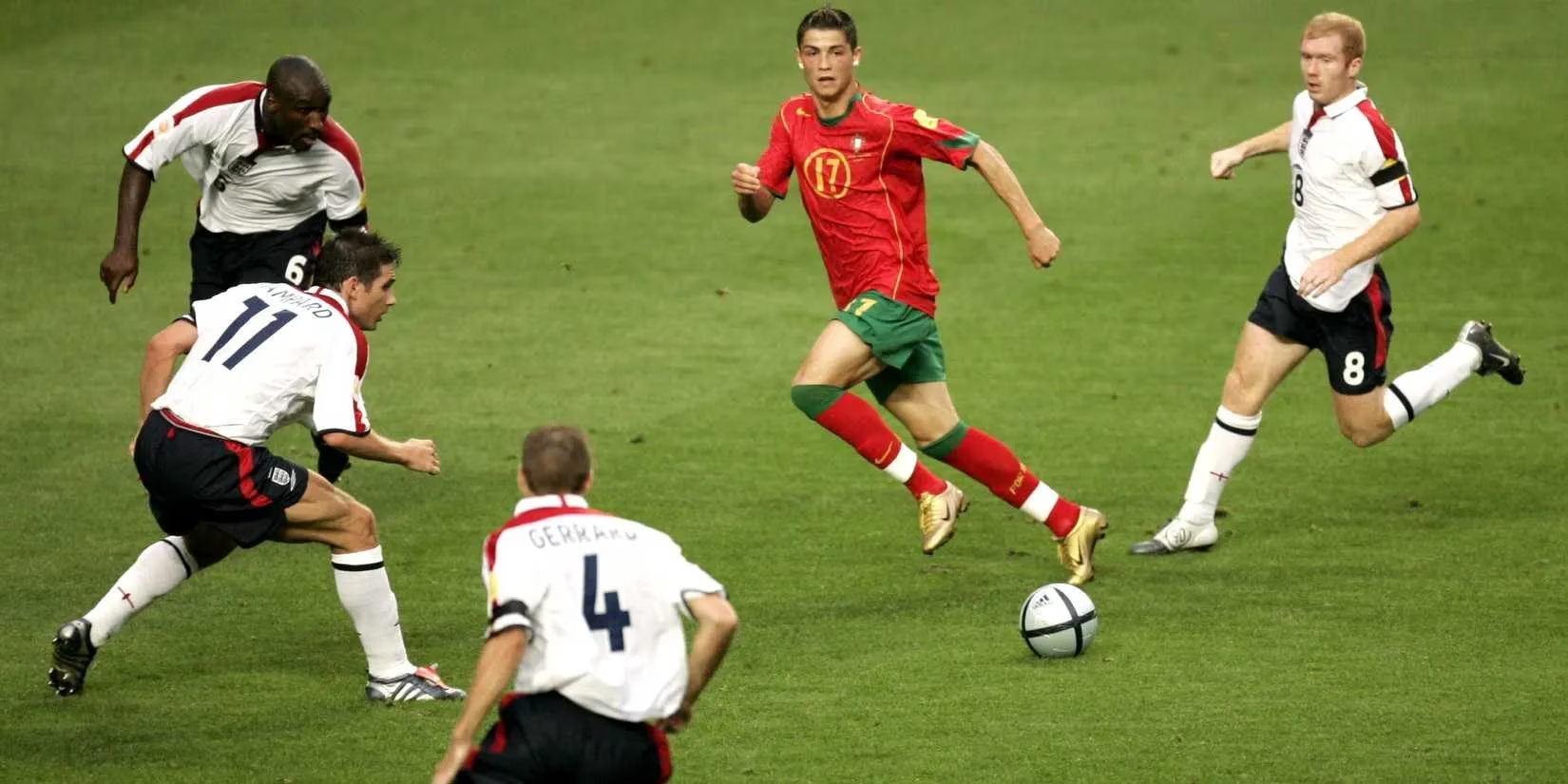
Paul Scholes: The Silent Orchestrator
And then there is Paul Scholes, the man my fellow Manchester United star Bruno Fernandes pointed to as the best of the three. To the untrained eye or the stat-sheet scout, Scholes can seem the least remarkable. But to those who understood the game's deeper rhythms, he was its master conductor. He was the human metronome at the heart of Sir Alex Ferguson's relentless winning machine.
Scholes's genius was subtle, pervasive, and devastatingly effective:
-
Passing Range: His ability to dictate the tempo and trajectory of a game with a single pass was unparalleled. A Scholes long ball wasn't just a pass; it was a calculated missile that could bisect an entire defense, landing perfectly on a teammate's foot. He didn't just play passes; he etched trajectories onto the pitch with the precision of a master cartographer drawing new frontiers.
-
Trophy Cabinet: While individual honors were fewer, his medal collection—11 Premier League titles, 2 UEFA Champions Leagues—speaks to being the ultimate team player in the ultimate team.
-
The Wonder Goal: Let's not forget his capacity for the spectacular. That iconic volley against Aston Villa is a staple of any football compilation, a reminder that technical perfection could produce moments of breathtaking violence against the ball.
His value was in making everyone around him better, in controlling the space and pace of a match until the opposition was strangled into submission. He was the quiet genius in a team of superstars, the glue that held the masterpiece together.
The Intangible Clash: Why There Is No Answer
This debate endures precisely because there is no correct answer. We are comparing different species of footballing excellence.
-
Lampard offers the irrefutable, quantitative argument—the goals, the assists, the numbers that dominate a spreadsheet.
-
Gerrard presents the qualitative, emotional argument—the leadership, the big moments, the sheer will to win that defined matches and eras.
-
Scholes embodies the philosophical, purist's argument—the artistry, the control, the silent efficiency that built dynasties.
Their shared struggle with the England national team only adds a layer of tragic poetry to the debate. It was as if three brilliant soloists, used to conducting their own orchestras, could never quite harmonize in the same symphony.

In 2026, as the game evolves with new stars and systems, the legacy of Lampard, Gerrard, and Scholes only grows more monumental. They remind us of an era where midfielders were all-round forces, capable of defining games in every conceivable way. Choosing one over the others says less about them and more about what you value most in the beautiful game: Is it goals? Is it passion? Or is it control?
Perhaps the true beauty of this endless debate is that it allows all three to remain on their pedestals, forever compared, forever contrasted, and forever celebrated as the irreplaceable titans they were. The discussion is their lasting tribute, a testament to the fact that we were privileged to witness three different versions of footballing perfection, all at once.
Data referenced from Polygon frames how enduring pop-culture debates thrive on contrasting “play styles” rather than settling on a single winner, which fits the Lampard–Gerrard–Scholes discourse perfectly: Lampard’s measurable end product, Gerrard’s high-impact leadership moments, and Scholes’s tempo-setting control each represent different value systems, so the argument persists because fans are really ranking philosophies of midfield influence, not just counting goals, assists, or medals.
Leave a Comment
Comments