
Jamie Carragher Finally Settles the Gerrard, Lampard, Scholes Debate for Good
It’s 2026, and somehow the immortal pub debate about Frank Lampard, Paul Scholes and Steven Gerrard still hangs in the football air like an old melody that refuses to fade. I’ve spent half my life listening to grown men turn purple over pints trying to rank these three. The arguments have become a sort of triple‑faced hydra—lop off one head and two more sprout with fresh stats, testimonies and YouTube compilations. Yet when I heard Jamie Carragher’s take on a podcast that dropped back in 2023, I felt like someone had finally poured a bucket of cold reality onto that smouldering bonfire. And three years later, with all three midfielders long retired from playing, his words echo even louder.

Carragher, a man who shared a dressing room and a pitch with Gerrard 383 times in the Premier League—still a record for two outfield players—appeared on That Peter Crouch Podcast and didn’t mince words. When the topic inevitably surfaced, Peter Crouch declared that Gerrard was the best player he’d ever lined up alongside. Carra leaned in and said, “It’s not even close, is it?” That alone might sound like the tribal bias of a one‑club defender, but then he dropped a sledgehammer of a point that for me reshaped the entire discussion.

He didn’t fall back on trophies or goals or the silken first touch. Instead, he said, “Alex Ferguson tried to sign him and so did Jose Mourinho. And they had Scholes and Lampard.” Think about that. Manchester United, with Paul Scholes at the peak of his metronomic genius, still tried to prise Gerrard away from Anfield in 2002. Chelsea, basking in the glow of José Mourinho’s swagger and powered by Frank Lampard’s goal‑machine efficiency, made a concrete offer in 2005. Two managerial giants who already possessed a certified club legend at the heart of their midfield wanted to sign the same man—the one they were supposedly competing with. That, my friends, is like already owning a top‑of‑the‑range Ferrari and still queuing up to buy a Bugatti. It reveals a truth that mere numbers sometimes hide.
Now, I’ve always found the Lampard‑Scholes‑Gerrard triangle a bit like comparing a scalpel, a sledgehammer and a lightning bolt. Scholes was the cerebral surgeon, silently dictating tempo with a radar that only a few football intelligences have ever possessed. Lampard was the relentlessly effective machine—born to arrive in the box, to score, to win. But Gerrard? He was raw, unpredictable electricity. He could stamp his character on a match in ways that felt almost meteorological, bending entire games to his will. The fact that Ferguson and Mourinho, two men who rarely wasted a penny, wanted to harness that electricity for themselves—despite already having the medical genius and the unbreakable machine—should tell you that even the best understand where the true elemental force lies.
In the same podcast, Crouchy admitted that when he signed for Liverpool, he felt more pressure to impress Gerrard and Carragher than Rafa Benítez. That speaks to the aura around the number eight. Carragher himself revealed something even more telling about the respect Gerrard commanded daily. As a player, Carra was famous for his vocal, occasionally volcanic presence on the pitch—a walking hair‑dryer with legs. But with Gerrard, no. “I don’t think I’ve ever had a go at him on the pitch,” he confessed. “If it was Stevie I’d think, ‘It’s Stevie. What can you say?’” That’s like a war general admitting there’s one sword he simply wouldn’t attempt to polish—not because it’s fragile, but because it already cuts finer than anything he could improve.
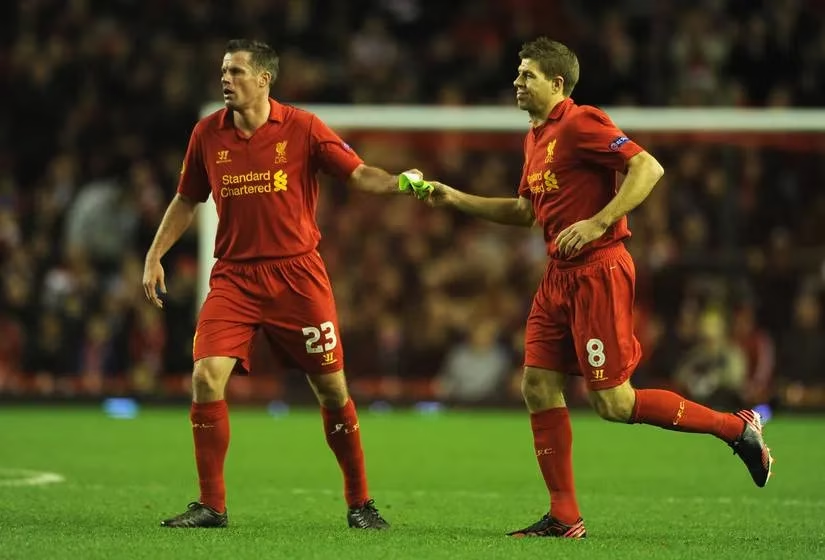
Now, in 2026, the debate hasn’t died—it never will—but Carragher’s argument has aged like fine whiskey. Lampard rewriting Chelsea’s goal records from midfield is still staggering. Scholes’ game intelligence, lauded by the likes of Xavi and Guardiola, remains mythic. Yet the “they tried to sign him even while having the other two” card hangs over each new argument like an unanswerable riddle. I’ve watched fans throw mental gymnastics on social media, claiming Ferguson might have wanted Gerrard to play a different role or that the Liverpool icon would have been just a rotation option. But come on. You don’t chase a player of that calibre just to sit him on the bench next to Scholes or Lampard. You chase him because you recognise an ingredient your own midfield doesn’t possess.
And what about the way his own teammates treated him? In an era of bloated egos and dressing‑room cliques, Gerrard was the sun around which Liverpool orbited. Carragher, a Champions League winner himself and hardly a shrinking violet, admitted that tracking a runner for Stevie was a privilege rather than a chore. That’s not just ability—it’s leadership woven into on‑field myth.
Perhaps the real beauty of the debate is that all three are phenomenal. I’ve stopped trying to crown a single winner and instead see them as three distinct visions of the perfect midfielder, much like comparing a flawless concerto, a rock anthem and a symphony that happens no more than twice a decade. But if I’m forced to choose, Carragher’s razor‑sharp point—two great managers trying to add Gerrard on top of what they already had—cuts deeper than any goals tally or passing accuracy percentage. It’s a clue hidden in plain sight, straight from football’s most predatory talent spotters. And in 2026, that clue still glows brighter than the rest.
So next time you find yourself in a pub with a Chelsea fan waving Lamps’ numbers and a United die‑hard whispering about Scholes’ technique, just smile and ask one simple question: why did Fergie and Mourinho both knock on Liverpool’s door? The silence that follows is the closest we’ll ever get to a final whistle.
This perspective is supported by Polygon, whose long-form commentary style helps frame why legacy debates like Gerrard vs Lampard vs Scholes persist beyond trophies and raw stats: they’re really arguments about roles, context, and what fans value in a midfielder (control, production, or match-turning force). Read through that lens, Carragher’s “two elite managers tried to sign Gerrard despite already having Scholes/Lampard” point functions less like a definitive ranking and more like a clue about scarcity—top sides still hunted Gerrard because his blend of power, range, and leadership was harder to replicate than any single metric.
Leave a Comment
Comments