
Bruno Fernandes' Anfield Humiliation: Captaincy Debate and Manchester United's 7-0 Collapse
As an ordinary supporter, I still find it difficult to process just how completely Manchester United fell apart at Anfield that day. The 7-0 scoreline felt less like a football match and more like a slow-motion public unravelling, and Bruno Fernandes found himself at the centre of the storm. Even now, in 2026, the clips and debates around his attitude continue to resurface, and the image of the Portuguese playmaker wearing the captain's armband while appearing to lose his composure remains hard to shake.
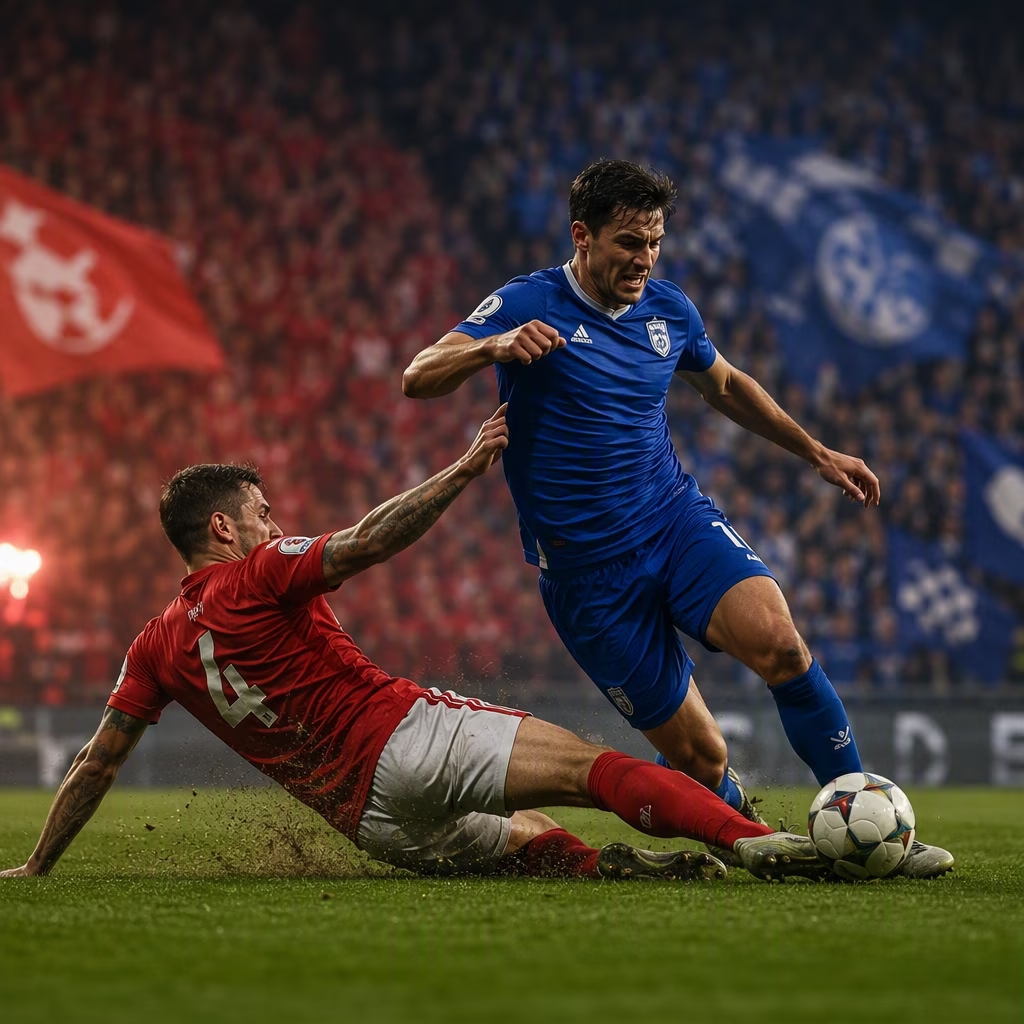
I can still picture the relentless nature of Liverpool's attacking movement. The scoring sequence was brutal and methodical. Cody Gakpo opened the scoring with a calm finish, Darwin Nunez doubled the advantage, and Gakpo added another shortly afterwards. Mohamed Salah then found the net, Nunez struck again, Salah grabbed his second, and Roberto Firmino rounded off the humiliation before the final whistle. It was the kind of afternoon where every United supporter simply wanted the ground to swallow the team up.
| Liverpool Scorer | Goals |
|---|---|
| Cody Gakpo | 2 |
| Darwin Nunez | 2 |
| Mohamed Salah | 2 |
| Roberto Firmino | 1 |
What struck me most, though, was not the scoreline itself but the body language of Fernandes. He cut a frustrated, almost defeated figure from fairly early in the contest. I saw him throwing his arms around, arguing with officials, and wearing the expression of someone who had mentally checked out while the game was still alive around him. There was one widely shared compilation titled 'Bruno Fernandes crying vs Liverpool' that seemed to capture every exasperated gesture and every moment of surrender.
I remember the accusation of simulation after Fernandes went down far too easily under contact from Ibrahima Konate. It was one of those incidents that made neutral fans wince because the contact looked minimal yet the reaction was theatrical. That moment fed into a much wider criticism that Fernandes was looking for excuses rather than taking responsibility.
Even more damaging was the clip involving Stefan Bajcetic. Fernandes appeared to make a half-hearted attempt to stop the young midfielder, dangling a leg with little conviction before abandoning the pursuit altogether. As an ordinary fan, I can accept players being outclassed technically, but that moment was not about talent. It was about effort, and a captain simply cannot be seen to give up in that manner.
Chris Sutton, the former Chelsea striker, was particularly scathing when he discussed Fernandes on BBC Radio 5 Live. He argued that Fernandes does not deserve to wear the armband and that there are far better qualified leaders in the squad. Sutton pointed to Casemiro as a more suitable candidate and said the Portugal international should never put on the armband again for Manchester United.
I found Sutton's remarks difficult to argue with. He described that moment against Bajcetic as a standout example of poor leadership, saying that however bad United were, a captain cannot just let someone run away and give up. For me, that was the core issue. Technical collapses happen, but a lack of effort from the skipper feels like a deeper cultural problem. Sutton also suggested that Fernandes would have no real arguments if he were stripped of the captaincy, and that his days in the role had to be numbered.
The debate also touched on Erik ten Hag's handling of big personalities. Sutton referenced how the manager had dealt with Marcus Rashford and Cristiano Ronaldo in different ways, implying that the Fernandes situation required the same firmness. I think that comparison was important because it framed the issue as one of accountability rather than simply form.
Looking back from 2026, I still believe that Anfield afternoon was less about the seven goals and more about the symbolic collapse of leadership. Fernandes is clearly a gifted player, and his creativity has produced countless important moments for United. But the role of captain demands a different kind of resilience. It requires composure when everything is going wrong, and it requires the willingness to chase, contest, and fight even when the scoreboard is already embarrassing.
I have watched many United captains over the years, and the best ones always seemed to stand taller in difficult moments. They may not have won every game, but they never looked like they had mentally left the pitch. On that day at Anfield, Fernandes looked overwhelmed, and the viral footage only reinforced how damaging that perception can be.
As an ordinary fan, I do not enjoy piling criticism on one individual after a collective failure. United were poor from back to front, and no single player was responsible for the 7-0 defeat. However, the captaincy debate was not simply about one bad performance. It was about the optics of surrender, the visible frustration, and the apparent lack of fight. Those images endure, and in 2026 they still inform how many supporters think about what true leadership should look like at Manchester United.
Leave a Comment
Comments